Sunday, March 3, 2013

The Reluctant Caregiver

By PAULA SPAN
February 20, 2013, 6:00am

Now and then, I refer to the people that caregivers tend to as "loved ones." And whenever I do, a woman in Southern California tells me, I set her teeth on edge.

She visits her mother-in-law, runs errands, helps with the paperwork — all tasks she has shouldered with a grim sense of duty.  She doesn't have much affection for this increasingly frail 90something or enjoy her company; her efforts bring no emotional reward. Her husband, an only child, feels nearly as detached. His mother wasn't abusive, a completely different scenario, but they were never very close.

Ms. A., as I'll call her because her mother-in-law reads The Times on her computer, feels miserable about this. "She says she appreciates us, she's counting on us. She thanks us," Ms. A. said of her non-loved one. "It makes me feel worse, because I feel guilty."

She has performed many services for her mother-in-law, who lives in a retirement community, "but I really didn't want to. I know how grudging it was."

Call her the Reluctant Caregiver. She and her husband didn't invite his parents to follow them to the small city where they settled to take jobs. The elders did anyway, and as long as they stayed healthy and active, both couples maintained their own lives. Now that her mother-in-law is widowed and needy, Ms. A feels trapped.

Ashamed, too. She knows lots of adult children work much harder at caregiving yet see it as a privilege. For her, it is mere drudgery. "I don't feel there's anybody I can say that to," she told me — except a friend in Phoenix and, anonymously, to us.

The friend, therapist Randy Weiss, has served as both a reluctant caregiver to her mother, who died very recently at 86, and a willing caregiver to her childless aunt, living in an assisted living dementia unit at 82. Spending time with each of them made Ms. Weiss conscious of the distinction.

Her visits involved many of the same activities, "but it feels very different," she said. "I feel the appreciation from my aunt, even if she's much less able to verbalize it." A cherished confidante since adolescence, her aunt breaks into smiles when Ms. Weiss arrives and exclaims over every small gift, even a doughnut. She worked in the music industry for decades and, despite her memory loss, happily sings along with the jazz CDs Ms. Weiss brings.

Because she had no such connection with her mother, whom Ms. Weiss described as distant and critical, "it's harder to do what I have to do," she said. (We spoke before her mother's death.) "One is an obligation I fulfill out of duty. One is done with love."

Unlike her friend Ms. A, "I don't feel guilty that I don't feel warmly towards my mother," Ms. Weiss said. "I've made my peace."

Let's acknowledge that at times almost every caregiver knows exhaustion, anger and resentment.  But to me, reluctant caregivers probably deserve more credit than most. They are not getting any of the good stuff back, no warmth or laughter, little tenderness, sometimes not even gratitude.

Yet they are doing this tough work anyway, usually because no one else can or will. Maybe an early death or a divorce means that the person who would ordinarily have provided care can't. Or maybe the reluctant caregiver is simply the one who can't walk away.

"It's important to acknowledge that every relationship doesn't come from 'The Cosby Show,'" said Barbara Moscowitz when I called to ask her about reluctance. Ms. Moscowitz, a senior geriatric social worker at Massachusetts General Hospital, has heard many such tales from caregivers in her clinical practice and support groups.

"We need to allow people to be reluctant," she said. "It means they're dutiful; they're responsible. Those are admirable qualities."

Yet, she recognizes, "they feel oppressed by the platitudes. 'Your mother is so lucky to have you!'" Such praise just makes people like Ms. A. squirm.

Ms. Moscowitz also worries about reluctant caregivers, and urges them to find support groups where they can say the supposedly unsay-able, and to sign up early for community services — hotlines, senior centers, day programs, meals on wheels — that can help lighten the load.

"Caregiving only goes one way – it gets harder, more complex," she said. "Support groups and community resources are like having a first aid kit. It's going to feel like even more of a burden, and you need to be armed."

I wonder, too, if reluctant caregivers have a romanticized view of what the task is like for everyone else. Elder care can be a wonderful experience, satisfying and meaningful, but guilt and resentment are also standard parts of the job description, at least occasionally.

For a reluctant caregiver, "the satisfaction is, you haven't turned your back," Ms. Moscowitz said. "You can take pride in that."

http://newoldage.blogs.nytimes.com/2013/02/20/the-reluctant-caregiver/

"Learn About Senior In Home Health Care in Inland Empire, California

Senior Helpers provides many services in the Inland Empire, California area. We provide a full array of home care services for seniors and the elderly living in this beautiful area. Our home care services are provided by bonded and insured employees and all employees pass a national background check.

If you need Home Care services in Corona, Chino, Chino Hills, Diamond Bar, Hemet, the Inland Empire, Moreno Valley, Murrieta, Norco, Perris, Riverside, Sun City Menifee, Temecula, Wildomar, and the surrounding areas we are an excellent choice with impeccable references. Home Health Care for your elderly loved ones is never an easy choice but we can promise we will do our best to make it as painless as possible. From our family to yours we sincerely thank you for considering Senior Helpers of Inland Empire Home Health Care Company.  "

Sunday, February 24, 2013

Sheriff’s department begins Alzheimer’s training

by Caitlin Huston                                         
Posted:  02/15/2013 5:57 AM
                                        
    In preparation for the passage of a bill currently headed to the Indiana statehouse, the Cass County Sheriff's has begun its Alzheimer's training.

    All of the department's officers are undergoing a six-hour training, administered by Senior Helpers, on how to interact with Alzheimer's patients during police business. The training comes as a bill requiring six hours of training on Alzheimer's disease for law enforcement was approved unanimously by the Indiana House and makes it way to the Senate.

    State Rep. Bill Friend, R-Macy, introduced the bill in January after a Peru police officer Tasered a 64-year-old nursing home resident with Alzheimer's. The patient was reportedly combative.

    Chief Deputy Jill Rife with the Cass County Sheriff's Department said they were contacted by Senior Helpers, an in-home senior care agency, and asked if they would be interested in Alzheimer's training.

    "I thought it was a good idea for the training," Rife said.

    Rife explained that the  officers currently undergo training on autism, mental illness, addictive disorders, mental retardation and developmental disabilities.

Department     But, she said she wanted officers to know how to interact with Alzheimer's patients, especially after the Peru incident.

    "They went through some scenarios and actually showed and taught them how to approach someone with Alzheimer's," Rife said.

    Dave Foreman, owner and director of Senior Helpers, said they began to offer law enforcement agencies training, which they typically give to caregivers, because of what happened in Peru.

    "That's what led me to want to get with these law enforcement officers," Foreman said.

    Foreman added that he has an article about the Tasering on his bulletin board.

    He said the training encompasses the different stages of Alzheimer's and what type of body language and speech pattern would be most effective with that person. For example, Foreman said they teach officers about not invading the space of the person they're talking with and being aware of the person's narrowed vision.

    "It can help tremendously," Foreman said.

    He added that he thinks the legislation is a good step.

    "I think it's a great legislation and that our training fits perfectly into that," Foreman said.
    This training will fulfill the department's requirements for 2013, Rife said.

    Caitlin Huston is a staff reporter of the Pharos-Tribune. She can be reached at 574-732-5148 or caitlin.huston@pharostribune.com.

http://m.pharostribune.com/PT/db_/contentdetail.htm?contentguid=kiHi47jJ&full=true#display

"Learn About Senior In Home Health Care in Inland Empire, California

Senior Helpers provides many services in the Inland Empire, California area. We provide a full array of home care services for seniors and the elderly living in this beautiful area. Our home care services are provided by bonded and insured employees and all employees pass a national background check.

If you need Home Care services in Corona, Chino, Chino Hills, Diamond Bar, Hemet, the Inland Empire, Moreno Valley, Murrieta, Norco, Perris, Riverside, Sun City Menifee, Temecula, Wildomar, and the surrounding areas we are an excellent choice with impeccable references. Home Health Care for your elderly loved ones is never an easy choice but we can promise we will do our best to make it as painless as possible. From our family to yours we sincerely thank you for considering Senior Helpers of Inland Empire Home Health Care Company.  "
Monday, February 18, 2013

Couple named 'longest married' in U.S. at 80 years

By Associated Press Published: Feb 6, 2013 at 10:34 AM PST Last Updated: Feb 6, 2013 at 12:15 PM

FAIRFIELD, Conn. (AP) - John and Ann Betar weren't supposed to get married. Her father had arranged for her to wed another man, but she and John fled Bridgeport and eloped in New York.

That was more than 80 years ago. The couple is still happily hitched, a fact that has led to their naming as the "longest married couple" in the U.S. for 2013 by Worldwide Marriage Encounter, a Christian marriage group based in San Bernardino, Calif.

The Betars are scheduled to receive a plaque and other gifts from the group at their granddaughter's home in Fairfield on Saturday.

They told the New York Daily News that there are no secrets to a long marriage, only a few simple rules.

"We just live with contentment and we don't live beyond our means," John Betar said. "Just go with the flow."

John's now 101 years old and Ann is 97, and they're still living in their home along the Fairfield shore. They had five children, 14 grandchildren and 16 great grandchildren. Two of their children died in their 60s.

Ron and Judy Pekny of Worldwide Marriage Encounter say the title of "longest married couple" is based on nominations the group received, so there may be some couples who have been married longer.

John and Ann grew up across the street from each other in Bridgeport, and John used to drive Ann to high school in his Ford Roadster. They fell in love. When her father arranged for her to marry someone else, they eloped in Harrison, N.Y., about 25 miles north of New York City.

John went on to open a grocery store in Bridgeport.

Ann Betar told the Hearst Connecticut Media Group around their 80th anniversary in November that family has been a key to their longevity.

"That's what makes life what it is," she said. "We were fortunate enough to live long enough to see this ... and it's really one of the most gratifying things in the world to see your great-grandchildren, to see your grandchildren become adults."

John Betar added, "That's what keeps us alive. We live for them."

http://www.komonews.com/news/offbeat/Couples-80-year-marriage-named-longest-in-US--190051051.html

"Learn About Senior In Home Health Care in Inland Empire, California

Senior Helpers provides many services in the Inland Empire, California area. We provide a full array of home care services for seniors and the elderly living in this beautiful area. Our home care services are provided by bonded and insured employees and all employees pass a national background check.

If you need Home Care services in Corona, Chino, Chino Hills, Diamond Bar, Hemet, the Inland Empire, Moreno Valley, Murrieta, Norco, Perris, Riverside, Sun City Menifee, Temecula, Wildomar, and the surrounding areas we are an excellent choice with impeccable references. Home Health Care for your elderly loved ones is never an easy choice but we can promise we will do our best to make it as painless as possible. From our family to yours we sincerely thank you for considering Senior Helpers of Inland Empire Home Health Care Company.  "

Sunday, February 10, 2013

A Little-Known Benefit for Aging Veterans

By Susan Seliger
September 19, 2012

Here's a riddle: When is a government benefit that pays for caregivers, assisted living and a nursing home not a benefit? When hardly any people know they're entitled to it.

That seems to be the story with a Department of Veterans Affairs benefit called the Aid and Attendance and Housebound Improved Pension benefit, known as A&A, which can cover the costs of caregivers in the home (including sons and daughters who are paid to be caregivers, though not spouses) or be used for assisted living or a nursing home.

The benefit is not insignificant: up to $2,019 monthly for a veteran and spouse, and up to $1,094 for the widow of a veteran.

Surprised that you've never heard of it? You're not alone.

"It's probably one of the lesser-known benefits," said Randal Noller, a Veterans Affairs spokesman in Washington. Of the 1.7 million World War II veterans alive as of 2011, who were in need of caregiving assistance and thus eligible, only 38,076 veterans and 38,685 surviving spouses were granted the A&A benefit that year, according to Mr. Noller.

Mr. Noller is not the first to acknowledge A&A is a well-kept secret. Jim Nicholson, former secretary of Veterans Affairs, said in a December 2006 news release that "not everyone is aware of his or her potential eligibility" for the program, which he called an "underused" benefit.

Not much has changed. A search of the Veterans Affairs Web site for evidence of public information efforts in the six years since came up blank.

"The sad thing is, it's been an entitlement for 61 years, but it's sat idle — the V.A. employees just haven't been educated about it," said Debbie Burak of Midlothian, Va. She said she repeatedly called department offices on behalf of her father, a World War II veteran, and her mother, who became homeless after their house caught fire and their injuries required extensive care. She was told there were no benefits they were entitled to. (Indeed, when I called two Baltimore-area Veterans Affairs offices for my father, a World War II veteran, no one had heard of this benefit or any benefit that paid for caregivers or assisted living or nursing homes.)

"My parents' end of life was so difficult. They lost everything, were living in a terrible hotel, ran up every credit card we had," Ms. Burak said. "My mother begged us not to cremate her, but there was no money for a burial; we had no choice."

It was only after her father died that Ms. Burak discovered her parents would have been entitled to as much as $160,000 over the last decade through the Aid and Attendance benefit. She applied, but no money arrived before her mother died.

Mr. Noller said the program's low visibility might be an effect of the size of the department. "The V.A. is the second-largest agency in the federal government, and you can't expect everybody to know everything," he said, referring to the agency's work force.

To bridge the information gap, Ms. Burak introduced VeteranAid.org, a Web site and a 501(c)(3) charity, in 2005, to provide information about A&A eligibility and how to apply.

To qualify, a veteran need not have suffered a service-related injury. He or she only had to have clocked at least one day of his or her 90-day minimum military service during a time of war and need caregiving for activities of daily living.

Applying can be confusing and arduous. If you know the program's name and search the Veterans Affairs Web site for Aid and Attendance, the first page states, among other things, that you are not eligible for A&A unless you already qualify for a basic Veterans Affairs pension — for which you have to be "totally disabled."

That's more than a little misleading.

"What people don't know is that when wartime veterans turn 65, the V.A. automatically classifies them as 'totally disabled,' " Ms. Burak said. And if they meet income and asset criteria, they are eligible for a basic pension.

The A&A benefit can be more than 50 percent higher than the basic veteran's pension ($24,239 annually for a veteran and spouse with A&A, versus $16,051 for a basic pension). The income and asset cutoffs are also higher than for A&A benefits.

Karen McCarty, of Fort Worth, is one of the lucky ones who applied for A&A — and got it. She heard about it when the assisted living facility where her father-in-law, Robert McCarty, 92, was living, held a seminar on it.

Ms. McCarty, a former certified public accountant, started researching the application process at the Veterans Affairs site, but, she said, "the VeteranAid.org site was much clearer." She found all the forms she needed, and her father-in-law received the first check in record time — six months.

Not all Veterans Affairs officers are in the dark about A&A.

After Annette Cadena's parents were in a car accident and moved to a nursing home in their tiny hometown, Fossil, Ore., it was the local Veterans Affairs officer, Paul Conroy (now retired), who saw her on the street and mentioned that her parents might qualify.

"I was skeptical, to be honest," said Ms. Cadena. "My husband did two tours in Iraq and has worked 30 years for the Washington State Army National Guard coordinating with the V.A. to help veterans, and he had never heard of it."

Still, she applied in August 2009, and nine months later her parents started receiving the maximum $2,019 per month.

The benefit was a lifesaver. That is, until her father, Clinton Ray, died on Aug. 5. The payments to her mother, Bessie Ray, stopped, even though widows of veterans are also entitled to this benefit.

"They cut her off cold," Ms. Cadena said, and told her she would have to apply all over again as a widow, which could take 9 to 18 months. "My mother said, 'Oh, my God, are they going to kick me out of the home?'" Ms. Cadena recalled.

Still, when the benefit comes through, it can make a real difference.

Marcia Hruska's mother, 85, had run through all her savings after seven years of worsening Alzheimer's and round-the-clock care in her apartment in Coconut Creek, Fla. Assisted living was the next step, but Ms. Hruska didn't know how they would pay for it, with Social Security her only income.

"One of the assisted living facilities we visited asked if my dad had been in the service," and mentioned A&A, Ms. Hruska recalled. So she filled out the 26-page Veterans Affairs application — which used to be only four pages — and on Sept. 1, six months after applying, she received the first monthly check for $1,019. "This relieves a lot of tension," Ms. Hruska said.

One warning note: Scams abound. The department forbids anyone to charge to help veterans fill out these challenging forms, yet a growing number of companies — many of which, on a Web search for "Aid and Attendance," pop up with waving flags and red-white-and-blue banners — offer to "help" veterans fill out the forms free, then charge thousands of dollars for financial consultation.

And, Ms. Burak warns: "Financial planners at assisted living facilities are putting on seminars about the A&A benefit — but it isn't out of the goodness of their hearts. They are trolling for residents who have too much money to qualify, to get them to move assets into annuity products that don't count as income or assets and yield big commissions." (This is possible because, unlike Medicaid, with its five-year lookback, Veterans Affairs has no lookback on asset transfers.)

The department does not reveal maximum allowable assets. But $80,000 (the house and a car are exempt from this total) seems to be in the ballpark, though someone with more assets could still qualify if expenses were very high, according to Ms. Burak.

Income limits are not set in stone either. But the maximum is around $20,000 to $23,000 after deducting costs for medical expenses, caregivers, assisted living or nursing home fees.

Some people are taking advantage of A&A to protect assets for their heirs, Ms. McCarty said. Still, she said,"it's a wonderful benefit."

http://newoldage.blogs.nytimes.com/2012/09/19/few-know-of-benefit-to-help-aging-veterans/

"Learn About Senior In Home Health Care in Inland Empire, California

Senior Helpers provides many services in the Inland Empire, California area. We provide a full array of home care services for seniors and the elderly living in this beautiful area. Our home care services are provided by bonded and insured employees and all employees pass a national background check.

If you need Home Care services in Corona, Chino, Chino Hills, Diamond Bar, Hemet, the Inland Empire, Moreno Valley, Murrieta, Norco, Perris, Riverside, Sun City Menifee, Temecula, Wildomar, and the surrounding areas we are an excellent choice with impeccable references. Home Health Care for your elderly loved ones is never an easy choice but we can promise we will do our best to make it as painless as possible. From our family to yours we sincerely thank you for considering Senior Helpers of Inland Empire Home Health Care Company.  "

Sunday, February 3, 2013

Did You Know? Caregiver Facts Across the US

Posted on Jan 29, 2013  | Comments (0)
                                    
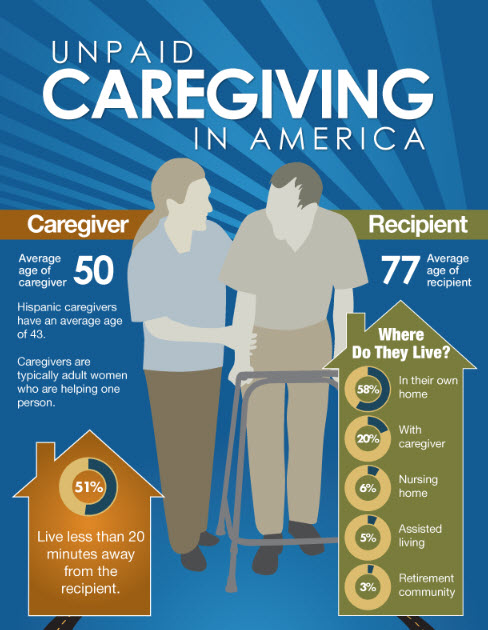
According to Seniors Digest, caregiving is one of the most stressful jobs in America, and for many, it is not their only job. The number of adults taking care of family members or friends increases daily, and the majority of these caregivers are not providing care for compensation.
Let's take a look at some caregiver facts across the US (Information source – www.caregiver.org)
Extent of Family Caregiving
  • 65.7 million Americans (29% of the US adult population) are providing care to someone who is ill, disabled, or aged
  • 52 million caregivers provide care to adults (aged 18+) with a disability or illness
  • 43.5 million Americans care for someone 50 years of age or older
  • 14.9 million care for someone who has Alzheimer's disease or other dementia
  • Caregivers of adults are now older, on average, than were their counterparts in 2004. Their average age now 49.2 years, compared to 46.4 in 2004
  • Unpaid family caregivers will likely continue to be the largest source of long-term care services in the US
With these increasing numbers, caregiver burnout is at a higher risk than ever. Caregiver burnout is a state of physical, emotional, and mental exhaustion. It can occur when home care providers don't get the help they need or if they try to do more than they are able to do.
Do you have caregiver burnout? Are you:
  • Withdrawing from friends, family, and other loved ones?
  • Feeling blue?
  • Experiencing changes in sleeping patterns?
  • Feeling like you want to hurt yourself or the person you are caring for?
  • Irritable?
  • Losing interest in activities you used to enjoy?
  • Seeing changes in your appetite, weight, or both?
  • Getting sick more often?
  • Emotionally or physically exhausted?
Senior Helpers is here to help relieve the stress and burdens of being a caregiver. Our services provide the break you need for your mental and physical health. Learn more about our services here!

https://docs.google.com/document/d/1HFoOm_ZUCw6gGjS-_Z2L-aZCWj4h71IjFYvoX04S4yA/edit

"Learn About Senior In Home Health Care in Inland Empire, California

Senior Helpers provides many services in the Inland Empire, California area. We provide a full array of home care services for seniors and the elderly living in this beautiful area. Our home care services are provided by bonded and insured employees and all employees pass a national background check.

If you need Home Care services in Corona, Chino, Chino Hills, Diamond Bar, Hemet, the Inland Empire, Moreno Valley, Murrieta, Norco, Perris, Riverside, Sun City Menifee, Temecula, Wildomar, and the surrounding areas we are an excellent choice with impeccable references. Home Health Care for your elderly loved ones is never an easy choice but we can promise we will do our best to make it as painless as possible. From our family to yours we sincerely thank you for considering Senior Helpers of Inland Empire Home Health Care Company.  "

Monday, January 28, 2013

Taking a Zen Approach to Caregiving

By Judith Graham

You try to help your elderly father. Irritated and defensive, he snaps at you instead of going along with your suggestion. And you think "this is so unfair" and feel a rising tide of anger.

How to handle situations like this, which arise often and create so much angst for caregivers?

Jennifer Block finds the answer in what she calls "contemplative caregiving" — the application of Buddhist principles to caregiving and the subject of a year-long course that starts at the San Francisco Zen Center in a few weeks.

This approach aims to cultivate compassion, both for older people and the people they depend on, said Ms. Block, 49, a Buddhist chaplain and the course's lead instructor. She's also the former director of education at the Zen Hospice project in San Francisco and founder of the
Beyond Measure School for Contemplative Care, which is helping develop a new, Zen-inspired senior living community in the area.

I caught up with Ms. Block recently, and what follows is an edited transcript of our conversation.

Q. Let's start with your experience. Have you been a caregiver?

A. My experience in caregiving is as a professional providing spiritual care to individuals and families when they are facing and coping with aging and sickness and loss and dying, particularly in hospital and hospice settings.

Q. What kinds of challenges have you witnessed?

A. People are for the most part unprepared for caregiving. They're either untrained or unable to trust their own instincts. They lack confidence as well as knowledge. By confidence, I mean understanding and accepting that we don't know all the answers – what to do, how to fix things.

This past weekend, I was on the phone with a woman who'd brought her mom to live near her in assisted living. The mom had been to the hospital the day before. My conversation with the daughter was about helping her see the truth that her mother needed more care and that was going to change the daughter's responsibilities and her life. And also, her mother was frail, elderly, and coming nearer to death.

Q. That's hard, isn't it?

A. Yes, because we live in a death-denying society. Also, we live in a fast-paced, demanding world that says don't sit still — do something. But people receiving care often need most of all for us to spend time with them. When we do that, their mortality and our grief and our helplessness becomes closer to us and more apparent.

Q. How can contemplative caregiving help?

A. We teach people to cultivate a relationship with aging, sickness and dying. To turn toward it rather than turning away, and to pay close attention. Most people don't want to do this.

A person needs training to face what is difficult in oneself and in others. There are spiritual muscles we need to develop, just like we develop physical muscles in a gym. Also, the mind needs to be trained to be responsive instead of reactive.

Q. What does that mean?

A. Here's an example. Let's say you're trying to help your mother, and she says something off-putting to you like "you've always been terrible at keeping house. It's no wonder you lost my pajamas."

The first thing is to notice your experience. To become aware of that feeling, almost like being slapped emotionally. To notice your chest tightening.

Then I tell people to take a deep breath. And say something to themselves like "soften" to address that tightness. That's how you can stay facing something uncomfortable rather than turning away.

If I were in this position, I might say something to myself like "hello unhappiness" or "hello suffering" or "hello aging" to tether myself.

The second step would be curiosity about that experience. Like, wow, where do I feel that anger that rose up in me, or that fear? Oh, it's in my chest. I'm going to feel that, stay with it, investigate it.

Q. Why is that important?

A. Because as we investigate something we come to understand it. And, paradoxically, when we pay attention to pain it changes. It softens. It moves. It lessens. It deepens. And we get to know it and learn not to be afraid of it or change it or fix it but just come alongside of it.

Over hours, days, months, years, the mind and heart come to know pain. And the response to pain is compassion — the wish for the alleviation of pain.

Let's go back to what mother said about your housekeeping and the pajamas. Maybe you leave the room for five minutes so you can pay attention to your reaction and remember your training. Then, you can go back in and have a response rather than a reaction. Maybe something like "Mom, I think you're right. I may not be the world's best housekeeper. I'm sorry I lost your pajamas. It seems like you're having a pretty strong response to that, and I'd like to know why it matters so much to you. What's happening with you today?"

Q. Are other skills important?

A. Another skill is to become aware of how much we receive as well as give in caregiving. Caregiving can be really gratifying. It's an expression of our values and identity: the way we want the world to be. So, I try to teach people how this role benefits them. Such as learning what it's like to be old. Or having a close, intimate relationship with an older parent for the first time in decades. It isn't necessarily pleasant or easy. But the alternative is missing someone's final chapter, and that can be a real loss.

Q. What will you do in your course?

A. We'll teach the principles of contemplative care and discuss them. We'll have homework, such as 'Bring me three examples of someone you were caring for who was caring toward you in return.' That's one way of practicing attention. And people will train in meditation.

We'll also explore our own relationship to aging, sickness, dying and loss. We'll tell our stories: this is the situation I was in, this is where I felt myself shut down, this was the edge of my comfort or knowledge. And we'll teach principles from Buddhism. Equanimity. Compassion. Deep inner connectedness.

Q.  What can people do on their own?

A. Mindfulness training is offered in almost every city. That's one of the core components of this approach.

I think every caregiver needs to have their own caregiver — a therapist or a colleague or a friend, someone who is there for them and with whom they can unburden themselves. I think of caregiving as drawing water from a well. We need to make sure that we have whatever nurtures us, whatever supplies that well. And often, that's connecting with others.

Q. Are other groups doing this kind of work?

A. In New York City, the
New York Zen Center for Contemplative Care educates the public and professionals about contemplative care. And in New Mexico, the Upaya Zen Center does similar work, much of it centered around death and dying.

People who want to read about this might want to look at a new book of essays, "
The Arts of Contemplative Care: Pioneering Voices in Buddhist Chaplaincy and Pastoral Work" (Wisdom Publications, 2012).

http://newoldage.blogs.nytimes.com/2013/01/11/taking-a-zen-approach-to-caregiving/?smid=fb-share


"Learn About Senior In Home Health Care in Inland Empire, California

Senior Helpers provides many services in the Inland Empire, California area. We provide a full array of home care services for seniors and the elderly living in this beautiful area. Our home care services are provided by bonded and insured employees and all employees pass a national background check.

If you need Home Care services in Corona, Chino, Chino Hills, Diamond Bar, Hemet, the Inland Empire, Moreno Valley, Murrieta, Norco, Perris, Riverside, Sun City Menifee, Temecula, Wildomar, and the surrounding areas we are an excellent choice with impeccable references. Home Health Care for your elderly loved ones is never an easy choice but we can promise we will do our best to make it as painless as possible. From our family to yours we sincerely thank you for considering Senior Helpers of Inland Empire Home Health Care Company.  "

Sunday, January 20, 2013

Elder Companions

What Elder Companions Do and How They Help

By Paula Spencer Scott, Caring.com senior editor
Last updated: September 29, 2012

Elder companions -- sometimes called home companions, who also cater to a younger population -- do just what the name implies: provide company for people who live alone, especially those who are homebound because of frailty or dementia. Most importantly, these companions function as an extra set of hands, eyes, and feet to the person you care for when you can't be there.
Specifically, most companions can assist with the following:
  • Meal preparation
  • Light housekeeping
  • Laundry
  • Grocery shopping
  • Errands

How they help

Elder companions are ideal for those who spend much of their time alone and require some assistance with basic daily tasks. Family members can work or handle other activities -- or simply take a few hours of respite -- while their loved one has company and some supervision. Companion care also provides valuable social benefits, decreasing isolation and improving quality of life. Warm relationships are often formed when a consistent companion is on the job -- a boon for both the companion and the person he or she visits.

What they cost
Cost can range from free services provided by local volunteers to between $10 to $25 per hour for help arranged through an in-home care agency, depending on the type of care needed, time of day, location, and services provided. Medicaid or Medi-Cal may help pay some of the costs of care from a licensed provider for those who have low income and few assets.

How to get started
You can find companions on your own in much the same way you'd find a babysitter: by talking to neighbors, friends, or family members. Or you can try these options:

  • In-home care agencies. Use Caring.com's Senior Living Directory to search for in-home care agencies, most of which provide elder companions, by city or zip code -- and to see ratings and reviews.
  • Meals on Wheels. In addition to providing the hallmark service they're known best for -- home deliveries of meals to older adults and others with mobility limitations -- many local Meals on Wheels programs provide outreach services, including a Friendly Visitor Program that pairs a volunteer with a neighboring senior. Begin your search for local help at the Meals on Wheels website.
  • Area Agencies on Aging. Trained staff at your local Area Agency on Aging can usually provide referrals for local help.
  • Local newspapers. Try placing an ad briefly describing your needs in a local newspaper.
  • Local high school students. Contact area high school counselors. College-bound students often need community service experience and are available to provide some care and company during afternoons and evenings.

http://www.caring.com/articles/caregivers-guide-to-elder-companions


"Learn About Senior In Home Health Care in Inland Empire, California

Senior Helpers provides many services in the Inland Empire, California area. We provide a full array of home care services for seniors and the elderly living in this beautiful area. Our home care services are provided by bonded and insured employees and all employees pass a national background check.

If you need Home Care services in Corona, Chino, Chino Hills, Diamond Bar, Hemet, the Inland Empire, Moreno Valley, Murrieta, Norco, Perris, Riverside, Sun City Menifee, Temecula, Wildomar, and the surrounding areas we are an excellent choice with impeccable references. Home Health Care for your elderly loved ones is never an easy choice but we can promise we will do our best to make it as painless as possible. From our family to yours we sincerely thank you for considering Senior Helpers of Inland Empire Home Health Care Company.  "